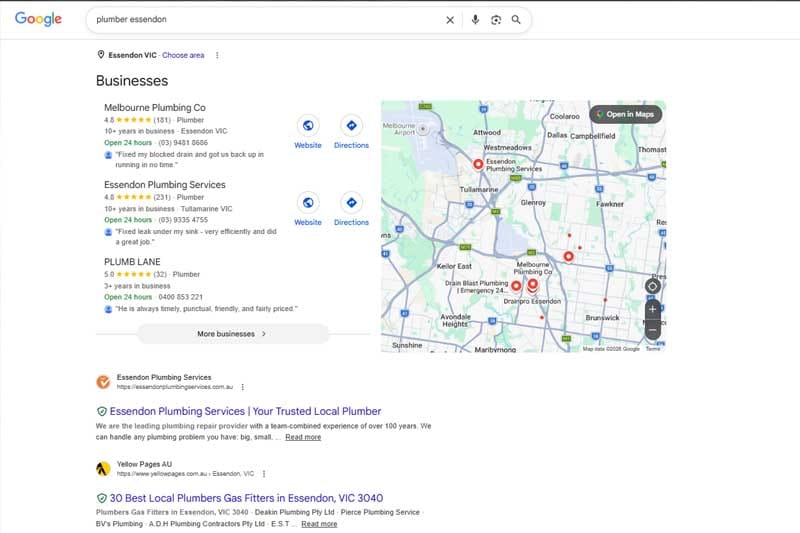
Essendon Business Owners: Here’s Why Your Competitors Rank Higher Than You
If you run a business in Essendon and you’re not showing up when locals search…
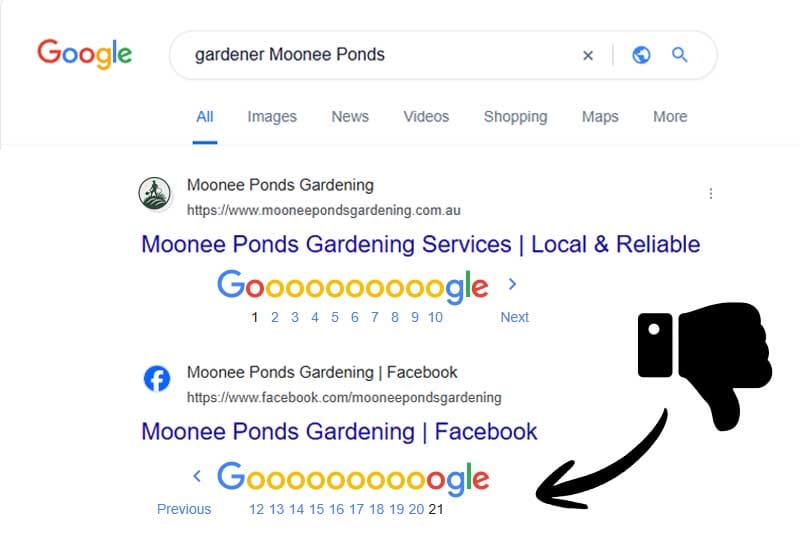
A lot of small business owners treat their Facebook page as their online presence and consider the job done. It’s free to set up, most of their existing customers are on it, and it feels like being on the internet. The problem is that for the customers who matter most, the ones actively searching for what you offer right now, a Facebook page is largely invisible, and the gap between what most owners think it’s doing for them and what it’s actually doing tends to be significant.
The stat that lands hardest when I explain this to clients is a simple one: organic reach for Facebook business pages sits at around 5.2%. If you have 1,000 followers, about 52 of them see any given post. Posts also disappear from feeds within roughly 48 hours whether anyone saw them or not. So your reach is already limited to people who already know you exist, and within that group, you’re only reaching a fraction of them, briefly.
The more important issue isn’t reach among your existing followers. It’s the people who don’t know you yet but are actively looking for someone who does what you do. Picture a Flemington resident whose hot water system has just failed at 8pm on a Wednesday. They’re not opening Facebook to look for help. They’re typing “emergency plumber Flemington” into Google, clicking one of the first few results, and calling whoever looks most credible. If you don’t have a website that shows up in that search, you don’t exist to that customer, regardless of how active your Facebook page is.
This is the distinction worth understanding clearly. Someone typing a service into Google has a specific, immediate need and is ready to act on it. Someone scrolling their Facebook feed is browsing passively, and Facebook’s algorithm is not designed to surface local service businesses at the moment someone urgently needs them. Nobody opens Facebook to find a dog trainer or a yoga studio or a sparky. They Google it. That’s where purchase intent lives, and a website is how you show up there.
When business owners check their Facebook insights and see that a post reached a few hundred people, it creates a feeling of activity. But reach on Facebook and qualified local customers searching for your service are completely different things. The people seeing your posts are existing followers who already know your business. You are not acquiring new customers through that reach. You’re maintaining low-level visibility with people who opted in to follow you, many of whom may not be in your service area or in the market for what you offer at any given time.
A website that ranks on Google works the other way around. It puts you in front of people who have never heard of you but are specifically searching for what you do, in your suburb, at the moment they need it. For any service business that depends on a steady flow of new customers, that’s the more valuable audience by a considerable margin.
This is the part that doesn’t come up enough. Your Facebook page belongs to Meta. You have access to it because they permit you to, and that permission can be withdrawn at any time for reasons that aren’t always clear and through a process that offers very little recourse. Account hacks are the most common cause. Someone reports your page for a spurious reason and it gets restricted while Meta reviews it. An algorithm update quietly collapses your reach overnight. A policy change affects how your business category can post. Any of these can happen without warning, and when they do, the standard response from Meta is a series of automated forms with no guarantee of a resolution timeline. There are agencies that exist solely to help businesses recover access to their own pages, which tells you something about how often it happens.
I’ve spoken to business owners who have lost months of posts, their entire follower base, and their primary customer contact point in one afternoon because their personal account, which the business page was tied to, was flagged and disabled. They had no backup. Everything they’d built on that platform was gone, and Meta’s support process gave them nothing useful for weeks.
A website you own and host isn’t subject to anyone else’s business decisions. Your service pages, contact details, photos, and any content you’ve built up stay exactly where you put them. You control when they change and how. For a business that relies on its online presence to generate work, that kind of stability matters.
The practical differences go beyond reach and ownership. A website that ranks on Google works continuously. A service page you built two years ago can still bring in enquiries today, because Google rewards relevance and authority over time. A well-maintained website with regularly updated content compounds in value the longer it exists. Facebook posts have a roughly 48-hour window before the algorithm stops showing them. There is no equivalent of a post from 2022 still generating leads in 2025.
A website also handles the convincing work that a Facebook page struggles to do. When someone finds you through Google and lands on your site, they can read about your services in detail, look through photos of your work, check your reviews, find your phone number, and decide whether to contact you, all without you doing anything. Research consistently shows that consumers consider a business significantly more credible when it has a dedicated website compared to one with only a social media presence. For trades and professional services especially, where someone is deciding whether to let you into their home or trust you with something important, that credibility gap is real and it affects whether they call you or the next person on the list.
If you want to know where you actually stand, type your service and your suburb into Google right now. “Plumber Moonee Ponds.” “Dog trainer Essendon.” “Yoga studio Ascot Vale.” Whatever applies to you. Look at what comes up on the first page. Those are the businesses getting the calls and the bookings. If you’re not there and your competitors are, then you already have your answer about what the Facebook page is doing for you.
The goal isn’t to abandon Facebook entirely. It has a legitimate place for staying in touch with people who already know your business, sharing updates, and running paid ads to a targeted audience. But none of that replaces a website that shows up when someone in your suburb is actively looking for what you offer. Those are two different jobs, and a Facebook page only does one of them.
If you’re not sure whether your current online presence is actually working for you, get in touch and we can take a look at where things stand.
Let's talk about your website and online presence. We'll talk about what's working (or not), and figure out if I can help your business get more customers online.
 Naomi Hermans
- Your website person -
Naomi Hermans
- Your website person -